
The growing conversation around mental illness and its subsequently amplified respect and sensitivity is a good thing. Talking about mental health issues is encouraged more than ever, and is possibly the zeitgeist of Generation Z. It’s sobering to think that up until The Mental Health Act of 2007, the mentally ill (not to be confused with the criminally insane) could not legally refuse electric shock therapy when detained by the state. Think about that: the government until very recently, could electrically pummel your brain, without any idea how it worked, in the hope that your scrambled cerebral jelly could somehow reconfigure: from 2003 to 2005, about 2,000 people a year in England and Wales were treated without their consent.
Fast-forward to 2020, and younger celebrities are congratulated for their struggles, by way of setting an example to their even younger fans: Selena Gomez cancelled tours due to anxiety, Ariana Grande opened up about PTSD, stress curtailed Justin Bieber’s workload. The message is very clear, you can be young, rich and pretty like Cara Delevigne and still be depressed – no wonder fat Alan in accounts is so glum!
It’s OK not to be OK, so the saying goes, therefore, we should talk about our feelings. That’s great. Except who the bloody hell should we talk to? Yes, we need better talkers, but we need even better listeners. The NHS, at least in my experience, has very little awareness of Pure OCD. Just a handful of non-profit organisations exist, my favourites are OCD Action and Made of Millions. However, they’re not able to – and shouldn’t be asked to – replace a public-funded health programme for Pure OCD.
Even if these third sector organisations were somehow magically funded by an altruistic billionaire, they would need to work closely with the NHS for pharmaceutical distribution. The NHS is needed, as private therapy is unattainable. Those weighed down by perpetual intrusive thoughts, suffocating guilt and depression rarely have the confidence and ability to hold down a job that affords £60-an-hour private-therapy sessions.
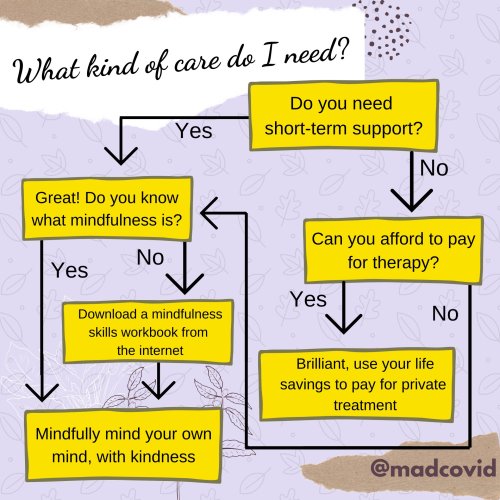
So yes, by all means, be aware of mental illness in your friends, colleagues and broader community. The issue is that governments and virtue signalling media outlets shouldn’t get away with conflating spreading awareness with real help.
“PRINCE WILLIAM AND LADY GAGA GET THEIR HEADS TOGETHER ON MENTAL HEALTH TO HELP SHOW YOUNG PEOPLE THAT IT’S OK”
Yeah, fine, thank you, but just talking isn’t what people need anymore. They need trained and empathetic people to understand them. They need investment in mental health infrastructure….the cultural climate, at least for the younger generation, has largely already changed. Maybe talking helped Prince William deal with the grief of prematurely loosing a parent, but a one-size-fits-all policy of public health campaigning isn’t sophisticated enough. We don’t need another multimillionaire putting their smiling face to a campaign. It’s so frustrating when probably well-intentioned people think they’ve resolved the mental health crises by telling people it’s OK to talk if they’re not able to listen.
There are two salient points as to why these well-intentioned media campaigns can be counter-productive, the first general to severe mental illness broadly, and the second quite specific to Pure OCD.
Firstly, the face of serious mental illness is someone choking on their tears, it’s someone making themselves bleed by way of distraction, it’s someone not having the energy to leave their bed, even to clean their teeth, for days on end. To these people, just making it through the day, at all, is an achievement.
Even if there was a completely vacuous yet beautiful celebrity that found fame and fortune by nothing but their looks, at the very least, they’re able to maintain a workout schedule, follow a prepared diet, have the confidence to attend photoshoots and red carpets, be comfortable speaking in public and hold meetings with their agents, PR team and a myriad of people. What I’m saying is…..this person is completely unrelatable to someone who’s too scared to get on a bus.
Secondly, and this is quite unique to Pure OCD….talking about the details of their mental health can be incredibly counter-productive! Yes, it can be good to talk in general terms about the disorder – otherwise, I wouldn’t be writing this – but seeking reassurance is the very thing that fuels Pure OCD! Talking about the ruminations one’s suffering from, unless when talking to professionals or helpful fellow sufferers – will make it impossible for them to recover! Which is why specialist treatment needs to be available……just talking isn’t enough.
 Coping with Pure OCD: How to live with intrusive thoughts
Leave a comment